


In this article, we will learn how to calculate the value of an electrical resistor using its color code, that is, the colored bands printed on the resistor body.
How to Calculate the Value of a Resistor 
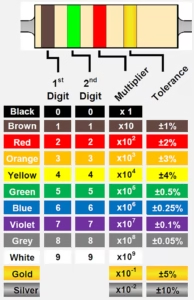
To determine the value of a resistor, observe that it typically has three adjacent color bands and a fourth band that is slightly separated.
Reading the color bands from left to right, the first three bands determine the nominal resistance value. The fourth band indicates the tolerance, meaning the permissible variation above or below the theoretical value defined by the first three bands.
Let’s review an example to better understand tolerance. If we have a 1,000-ohm (Ω) resistor with a tolerance of 10%, this means the nominal value is 1,000 Ω, but the actual resistance may vary by ±10% of 1,000 Ω. In this case, 10% of 1,000 Ω is 100 Ω.
Therefore, the actual resistance may range between 900 Ω and 1,100 Ω due to its tolerance.
In practice, when measuring resistors with a multimeter, the measured values are usually quite close to the nominal value, regardless of their specified tolerance.
Now that we understand tolerance, let’s see how to calculate the resistance value itself.
The color of the first band represents the first significant digit of the resistance value.
The second band represents the second significant digit.
The third band indicates the multiplier, that is, the factor by which the first two digits must be multiplied. Alternatively, it can be interpreted as the number of zeros that must be added to the two digits obtained from the first two bands.
Let’s look at some examples.
Imagine the following resistor:
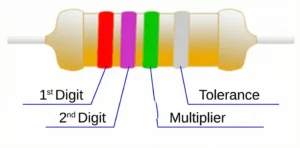
Resistor-parts
The first color indicates a value of 2, the second a value of 7, forming 27. The third band indicates a multiplier of 100,000 (or adding five zeros). Therefore, the resistor value is 2,700,000 ohms (2.7 MΩ). Easy, right?
What about its tolerance? Since the fourth band is silver, the tolerance is 10%. In reality, this resistor may vary by ±10% of 2,700,000 Ω. That means it can differ by ±270,000 Ω from its nominal value.
The resistor shown in the color code table image (above) is black–red–green: 0–2 with a multiplier of 100,000, which results in 200,000 Ω, with a 10% tolerance.
A resistor with the following colors: green–black–brown (brown is the coffee color) corresponds to 5–0 with one additional zero from the brown multiplier, resulting in a value of 500 Ω.




sales@logicbus.com | support@logicbus.com | +1 619 616 7350 | Start conversation