

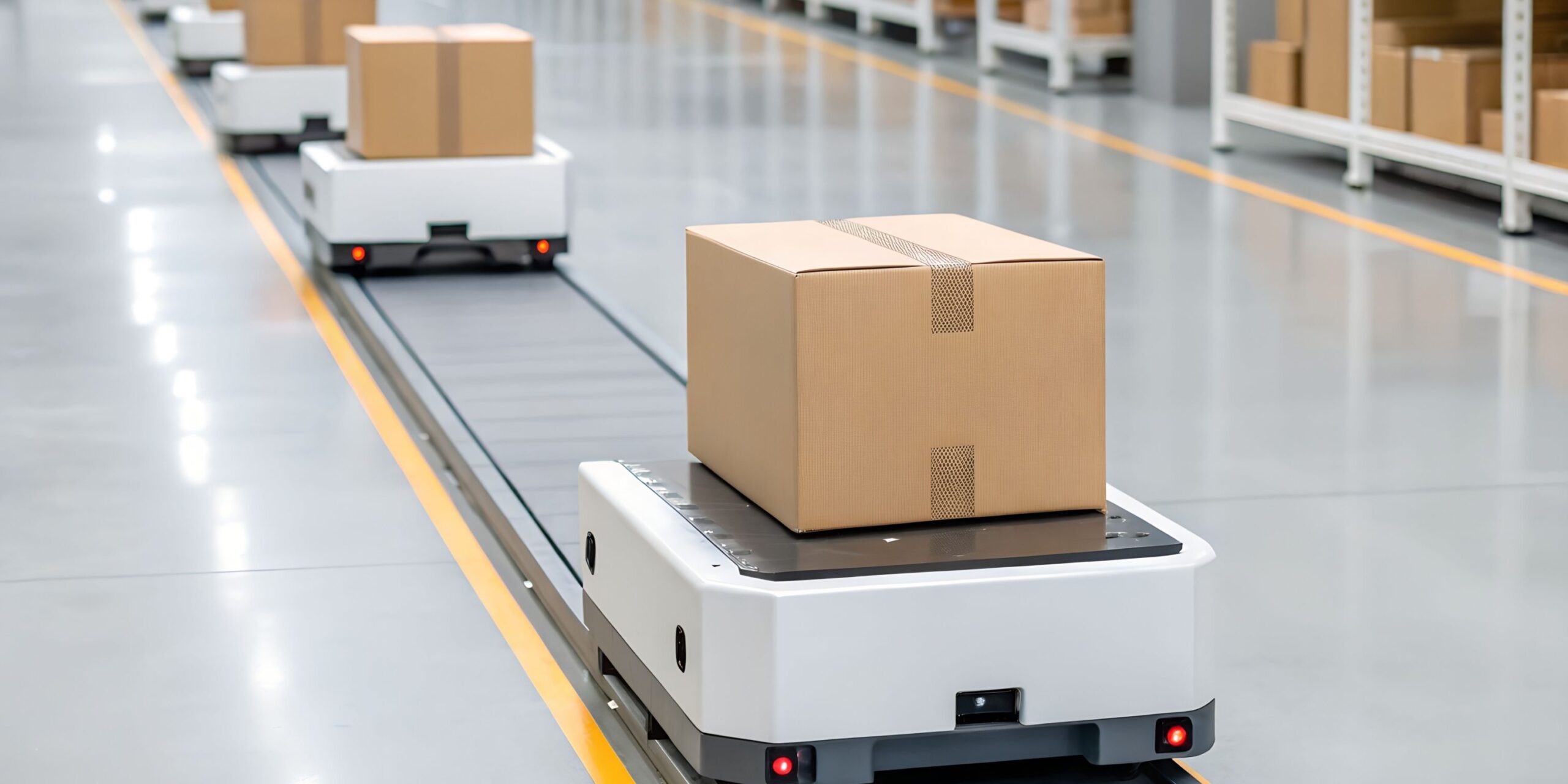
Understanding the Core of Autonomous Mobility
Autonomous Mobile Robots (AMRs) have become a cornerstone of modern industrial automation. Unlike traditional AGVs (Automated Guided Vehicles), AMRs don’t rely on fixed paths or magnetic tapes; instead, they use sophisticated navigation systems that allow them to move freely, adapt to dynamic environments, and optimize their routes in real time.
Among the most advanced in the field, Youibot’s AMRs stand out for their cutting-edge navigation technologies, integrating multiple sensors, mapping algorithms, and intelligent control systems to achieve precise and reliable movement across complex industrial spaces.
Key Navigation Technologies in Youibot AMRs 
1. SLAM (Simultaneous Localization and Mapping)
At the heart of every Youibot AMR is SLAM technology — a process that enables the robot to build and update a map of its surroundings while simultaneously determining its own position within that map.
Youibot integrates LiDAR sensors, vision cameras, and IMUs (Inertial Measurement Units) to create highly detailed and dynamic maps. This multi-sensor fusion allows the AMRs to recognize changes in the environment and adjust their path without human intervention, ensuring continuous operation even in busy factory floors.
2. LiDAR-Based Navigation
LiDAR (Light Detection and Ranging) provides the primary perception capability for Youibot robots. By emitting laser pulses and measuring the reflected light, the AMR can detect obstacles, walls, and objects with centimeter-level accuracy.
This data is processed in real-time by the onboard computing unit, enabling the robot to navigate narrow aisles, avoid collisions, and select the most efficient path toward its destination — all while maintaining smooth and safe operation.
3. Vision-Assisted Perception
Beyond LiDAR, vision-based systems enhance the spatial awareness of Youibot AMRs. Cameras detect floor markings, shelves, and human operators, providing additional layers of environmental understanding.
This visual feedback is especially valuable in mixed environments where AMRs interact closely with workers or other mobile systems, ensuring adaptive and safe navigation through complex scenarios.
4. Sensor Fusion and Data Processing
Youibot’s navigation systems rely on sensor fusion algorithms that combine data from multiple sources — LiDAR, vision, IMU, and wheel encoders — into a unified model of the environment.
Through advanced AI-driven path planning, the robot can identify optimal routes, recalculate paths in real-time when obstacles appear, and even predict movement patterns of surrounding entities. This intelligent coordination significantly enhances both efficiency and safety.
Adaptive Path Planning and Dynamic Obstacle Avoidance
One of the standout capabilities of Youibot’s AMRs is their dynamic path optimization. When obstacles are detected — whether static or moving — the robot recalculates its route instantly, maintaining task continuity.
This adaptability is powered by real-time computing and deep learning-based prediction models, which anticipate potential collisions and determine safe detours within milliseconds.
Such responsiveness is crucial in industrial environments, where forklifts, workers, or equipment might interrupt predefined routes.
Integration with Industrial Systems
Youibot AMRs are designed for seamless integration with MES, ERP, and WMS systems, allowing them to receive tasks, report status, and update workflow information automatically.
Their navigation systems are also compatible with multi-robot coordination frameworks, ensuring that several AMRs can operate collaboratively without traffic jams or idle time.
This synchronization, supported by precise localization, makes Youibot’s solutions ideal for smart factories, laboratories, and logistics centers seeking high scalability and flexibility.
Future of AMR Navigation
The next generation of Youibot navigation systems is moving toward AI-enhanced predictive navigation and cloud-based map sharing.
By leveraging edge computing and 5G connectivity, future AMRs will share real-time data with other robots and centralized control systems, creating a fully connected autonomous ecosystem.
This evolution will not only boost operational efficiency but also enable autonomous decision-making at scale, redefining the standards of industrial mobility.
Conclusion
Youibot’s approach to AMR navigation blends hardware precision with intelligent software architecture, resulting in robots capable of operating safely, efficiently, and autonomously in diverse industrial environments.
From SLAM-based mapping to real-time path optimization and collaborative operation, these systems exemplify how advanced navigation is driving the next frontier of automation.




sales@logicbus.com | support@logicbus.com | +1 619 616 7350 | Start conversation