


In the food and beverage industry, precision and consistency are everything. Whether producing sauces, beverages, or baked goods, even the slightest variation in ingredient proportions can affect product quality and compliance. That’s where an Automated Batching and Recipe Management System comes in — a solution designed to eliminate human error, streamline production, and ensure complete traceability from raw materials to final product.
How the System Works
The Automated Batching and Recipe Management System integrates advanced control hardware and software to handle every step of the batching process with accuracy and reliability.
1. Recipe Selection
The process begins with an operator selecting a recipe from a touchscreen HMI P5070NB. The system then retrieves the exact ingredient list and corresponding quantities from internal memory or a central database, ensuring that the correct formulation is always used.
2. Ingredient Dosing (Gravimetric and Volumetric)
At the heart of the process is a PLC ME1C1-1616T, which controls the sequence of ingredient dosing:
-
Weight-Based Dosing: The PLC communicates with a load cell module M02LCR, connected to load cells FSH04521 on the mixing tank. After taring, the system regulates a valve or feeder to reach the target weight for each ingredient precisely.
-
Volume-Based Dosing: For liquid ingredients, the PLC operates a pump with feedback from a capacitive sensor KAS-80-35-A-M32-PTFE-120C-Z02-1-HP, ensuring accurate volume measurement.
3. Process Control
Once the ingredients are dosed, the PLC coordinates the mixing and processing stages, controlling timing and sequence to guarantee consistency in every batch.
4. Traceability and Lot Tracking
Before adding any ingredient, the operator confirms its lot number via the HMI. The PLC records all relevant data — including actual weights, volumes, lot numbers, and timestamps — providing a full traceability record for each batch.
5. Batch Reporting and Data Integration 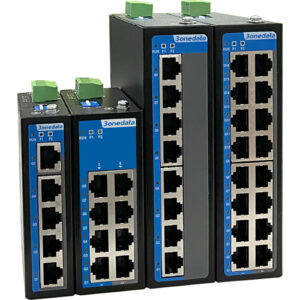
When the batch is complete, the HMI P5070NB automatically generates a detailed batch report. This information can be exported to a USB drive or transmitted directly to an ERP system through an industrial Ethernet switch IES2300SL-5GT-2LV, ensuring seamless data integration and compliance documentation.
Key Benefits of an Automated Batching and Recipe Management System
-
Guaranteed Consistency: Each batch is produced following the exact recipe specifications, ensuring uniform product quality.
-
Error Elimination: Automation removes the risks associated with manual dosing and operator mistakes.
-
Complete Traceability: Every ingredient is tracked from receipt to final product, simplifying audits and regulatory compliance.
-
Reduced Waste: Accurate dosing minimizes raw material losses and overfills.
-
Improved Efficiency: Automated sequencing reduces cycle times and increases production throughput.
-
Regulatory Compliance: Facilitates adherence to FDA and other food safety standards through precise documentation and control.
Conclusion
Automating the batching and recipe management process is no longer a luxury — it’s a necessity for manufacturers seeking to enhance product quality, improve traceability, and maintain compliance in a competitive market. With robust hardware like the PLC ME1C1-1616T, HMI P5070NB, and load cell modules M02LCR, production lines can achieve a new level of precision and reliability that manual systems simply can’t match.




sales@logicbus.com | support@logicbus.com | +1 619 616 7350 | Start conversation