


In the automotive industry, long-term reliability isn’t optional it’s essential. Vehicle seats, suspension springs, and even door hinges must withstand years of constant use, sudden impacts, and dynamic loads without failing or producing unwanted noise. To guarantee this durability, manufacturers increasingly rely on automated fatigue testing systems capable of compressing years of real-world wear into a controlled, repeatable, and accelerated laboratory process.
This blog explores how an integrated test setup powered by precision force sensors, advanced PLC control, and cloud-connected monitoring allows automotive engineers to validate product quality, detect early structural weaknesses, and run continuous tests with minimal human intervention.
How the Automated Fatigue Test System Works
1. Precision Force Measurement 
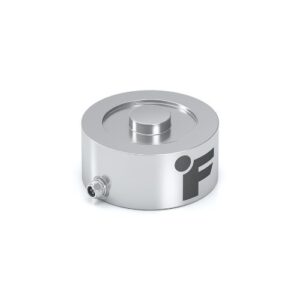
At the core of the test station is a button-type load cell (FSH04545) mounted beneath the vehicle seat or mechanical component under test. This load cell accurately captures the force applied by a hydraulic actuator during each compression cycle.
The force signal is routed through a FSH03863 signal amplifier, generating a clean ±0 to 10 VDC analog output. This amplified signal feeds directly into the PLC’s analog inputs, ensuring high-quality, real-time feedback for closed-loop force control.
2. Intelligent Cycle Control
A ME1C1-1616T PLC orchestrates the entire testing sequence. It commands the actuator to compress the seat or spring to a defined force such as simulating an 80 kg occupant and then release it. This process is repeated thousands or even millions of times to simulate long-term wear.
As the test progresses, material degradation or micro-cracks cause subtle drops in resistance. Because the PLC continuously evaluates the force profile, any abnormal drop is immediately detected. Once an anomaly is identified, the system automatically halts the test to prevent further damage and preserve the integrity of the evaluation.
3. Real-Time Local and Remote Monitoring
To simplify on-site supervision, a P5070NB HMI is installed near the test rig, giving operators full insight into cycle counts, force curves, alarms, and current test status.
Connectivity is handled by an IES2300SL-5GT-2LV Ethernet Switch, enabling robust communication between the PLC, HMI, and remote systems. Through a modem, all collected data is transmitted to the FATEK cloud service, utilizing an IOT-IMON-NN0010 IoT license for seamless online access.
Engineers can review dashboards, receive alerts, and monitor test progression from anywhere whether through FATEK’s IoT App or a web browser using a rugged EM-Q16-4G-64G-LTE Industrial Tablet. This mobility makes it possible to inspect the machinery in person while staying fully connected to real-time data.
Key Advantages of Automated Fatigue Testing
Ensures adherence to safety and durability standards
Manufacturers can validate crashworthiness, operational lifetime, and structural integrity before reaching production.
High-precision force feedback catches early failures
The load cell system identifies micro-fractures or weakened materials long before catastrophic failure occurs.
Enables continuous, unattended operation
Automated cycling supports 24/7 endurance testing, drastically reducing labor requirements and improving consistency.
Built for long-term, high-cycle operations
The control architecture is designed to manage millions of cycles without performance degradation.
Conclusion
Automated seat and suspension fatigue testing is a critical part of the automotive development process. By integrating high-precision sensing, intelligent PLC control, cloud-based monitoring, and rugged mobile visualization tools, manufacturers can confidently evaluate component durability while boosting safety, reliability, and productivity. This type of system not only accelerates testing but also ensures that potential failures are identified early long before they can impact vehicle performance on the road.




sales@logicbus.com | support@logicbus.com | +1 619 616 7350 | Start conversation