


The Critical Role of Signal Integrity in Modern Vehicles
Modern automotive systems are defined by their interconnectedness, relying heavily on Electronic Control Units (ECUs) and high-speed communication networks like CAN, LIN, and FlexRay. As vehicles become more complex, the reliability of these data links—which control safety-critical functions such as ABS, airbags, and engine management—is paramount.
In the Research & Development (R&D) and Quality Assurance (QA) phases of automotive electronics, the focus shifts to validating signal integrity. The challenge is ensuring that data transmitted between sensors and the central computer remains clean, noise-free, and adheres strictly to timing specifications. Failure to detect degradation or noise can lead to dangerous operational errors and costly product recalls.
This article details a robust application methodology designed to analyze and validate ECU and CAN Bus signal integrity using professional test equipment, optimizing both development time and final product reliability.
How It Works: A Comprehensive Test Bench Setup
Effective signal integrity analysis requires simultaneous capture of both digital data packets and underlying analog waveforms. Our solution integrates specialized hardware and software components to achieve this comprehensive analysis:
1. High-Fidelity Signal Acquisition 
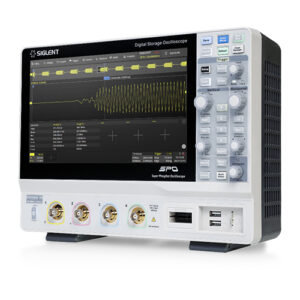
A core component is the SDS2204X HD Digital Oscilloscope. Connected directly to the vehicle’s CAN Bus ports or the ECU pins, this high-bandwidth instrument is used to capture and decode data.
Using the SDS2000HD-CANFD software, engineers can perform two critical functions simultaneously:
-
Decode High-Speed Data: Instantly decode CAN data packets to verify message content and timing.
-
Analyze Analog Waveforms: Capture the physical voltage signals to detect subtle forms of signal degradation, transient noise, or “ghost” signals that could corrupt data transmission.
2. Simulating Real-World Anomalies
To rigorously test the ECU’s robustness, the system must simulate fault conditions that might occur during vehicle operation. This is achieved using programmable power and signal generation tools:
-
Voltage Simulation: A programmable DC power supply, such as the SPD3303X, is used to inject controlled voltage drops. This simulates power anomalies like a faulty alternator or battery degradation, testing the ECU’s behavior under unstable power conditions.
-
Sensor Noise Injection: The arbitrary waveform generator option available within the SDS2000HD-FG software is employed to inject specific, noisy sensor signals. This simulates loose connections or environmental interference, ensuring the ECU maintains stability and correct data interpretation despite signal disturbances.
3. Data Logging and Robust Control Interface
Testing often occurs in demanding environments (garages, workshops, or test labs) that require durable equipment.
-
The SDS2204X HD Oscilloscope is connected via LAN to a robust Industrial Panel PC, such as the TPC-DCS.
-
Engineers manage the test sequence using an industrial-grade interface: the oil-resistant keyboard (D-87W) and mouse (D-SME20-Black). This setup ensures the control equipment can withstand dust, grease, and mechanical stress, providing reliable operation even when handled with gloves.
Application Benefits: Driving Reliability and Cost Reduction
Implementing this specialized signal integrity test bench delivers measurable advantages across the entire product lifecycle:
-
Ensured Safety Compliance: Guarantees that safety-critical systems (braking, steering, restraint systems) communicate flawlessly and without protocol errors, meeting stringent regulatory requirements.
-
Reduced Troubleshooting Time: The ability to decode CAN Bus protocols directly on the oscilloscope screen allows engineers to quickly pinpoint the source of communication failures, accelerating diagnosis from hours to minutes.
-
Enhanced Operational Durability: The use of robust industrial HMI components ensures continuous operation and minimizes downtime due to equipment failure in challenging lab or workshop settings.
-
Mitigation of Recall Risks: By detecting subtle electronic glitches and timing anomalies before mass production, manufacturers can prevent costly and reputation-damaging vehicle recalls associated with electronic system failures.
This integrated approach to signal integrity analysis is crucial for developing the next generation of reliable, autonomous, and safe vehicles.




sales@logicbus.com | support@logicbus.com | +1 619 616 7350 | Start conversation