


In high-velocity logistics, operational integrity relies on the transition from simply “moving” material to “quantifying” every movement. In Automated Storage and Retrieval Systems (AS/RS), load cells have evolved from simple scales to critical sensors for safety, logic, and inventory control. This guide explores the engineering principles and integration strategies of force measurement in automated environments.
1. Engineering Fundamentals: Force Transduction and Signal Integrity
At its core, a load cell is a transducer that converts mechanical force into a measurable electrical signal. In industrial AS/RS, the Strain Gauge Load Cell is the standard, utilizing a Wheatstone Bridge circuit to detect micro-deformations in a metal body.
The output voltage is defined by the relationship:
Where:
-
$V_{in}$: Excitation voltage.
-
$GF$: Gauge Factor (sensitivity of the strain gauge).
-
$\epsilon$: Mechanical strain.
To maintain accuracy in environments with high electromagnetic interference (EMI) from VFDs and motors, the “signal chain” must include high-speed digital transmitters. These devices perform 24-bit A/D conversion and galvanically isolate the signal before it reaches the PLC or Warehouse Control System (WCS).
2. Specialized Sensor Geometries for AS/RS
Selecting the correct sensor geometry is critical for long-term fatigue life and measurement precision.
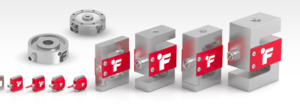
Low-Profile (Pancake) Sensors: Structural Safety
In stacker cranes and shuttle platforms, vertical space is at a premium. Pancake load cells are used for high-capacity compression sensing. Their high natural frequency and low deflection make them ideal for dynamic weighing.
-
Application: Overload protection at induction points to prevent racking structural failure.
S-Beam and In-Line Sensors: Tension/Compression Dynamics
Used in conveyor tensioning or autonomous towing mechanisms. In mobile robotics, these sensors monitor the drawbar pull to ensure the motor torque limits are not exceeded.
-
Application: Monitoring towing force in autonomous material movers to prevent drivetrain wear.
Miniature Load Buttons: The “Sense of Touch”
For Miniload systems and robotic picking, miniaturized sensors are integrated into end-effectors (grippers).
-
Application: Real-time inventory validation by weight. By measuring the mass of an extracted bin, the system performs an automated audit, detecting missing items or “ghost” inventory without human intervention.
3. Advanced Perception: Center of Gravity (CoG) and Multi-Axis Analysis
Modern high-density racking requires more than just “total weight” data. Utilizing Multi-Axis sensors (measuring $F_x, F_y, F_z$ and moments $M_x, M_y, M_z$), the system can calculate the Center of Gravity in real-time.
If a pallet is detected as off-center beyond a specific threshold, the WCS can autonomously:
-
Reduce acceleration/deceleration curves of the shuttle to prevent tipping.
-
Trigger a re-alignment cycle at the workstation.
-
Reject the load before it enters high-speed vertical lifts.
4. Synergy with Autonomous Mobile Robots (AMR) 
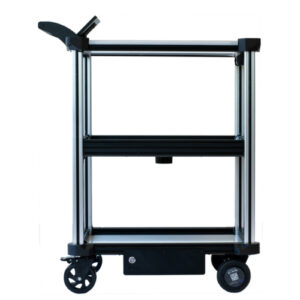
The data generated at fixed weighing stations is the primary safety input for autonomous fleets. High-precision sensors (such as the Futek series) provide the telemetry needed for robots like the Quasi Robotics Model C2.
-
Payload Stabilization: Weight data informs the AMR’s SLAM (Simultaneous Localization and Mapping) algorithm. Accurate mass input allows the robot to adjust its braking distance and inertial compensation, maintaining navigation stability even at maximum capacity (e.g., 79 kg).
-
Predictive Maintenance: Continuous monitoring of weight-induced fatigue on the robot’s suspension and drivetrain allows for a transition from reactive to predictive maintenance schedules.
5. Data Connectivity and Industrial Protocols
The transition from analog to digital is mandatory for Industry 4.0. Modern load cell transmitters must support deterministic communication:
| Protocol | Implementation Layer | Benefit |
| EtherNet/IP / PROFINET | PLC / Stacker Crane Control | Real-time safety interlocks and motion control. |
| Modbus TCP/IP | SCADA / HMI | Detailed telemetry and historical data logging. |
| MQTT | Cloud / IIoT Gateway | Remote monitoring of structural health and fatigue analysis. |
Technical Selection Criteria Summary
When specifying load cells for automated environments, the focus should be on Fatigue Life (aiming for $>100$ million cycles) and Sampling Rate (minimum $1000$ Hz). These parameters ensure that the system can perform “weigh-on-the-fly” operations without slowing down the warehouse cycle time.
Conclusion
Integrating precision weighing into the AS/RS architecture is an investment in operational resilience. By utilizing high-precision sensors and robust signal conditioning, the logistics facility transforms into a data-driven ecosystem. This technical approach eliminates structural risks, ensures 100% inventory accuracy, and provides the foundation for truly autonomous material movement.




sales@logicbus.com | support@logicbus.com | +1 619 616 7350 | Start conversation