


In industries such as pharmaceuticals and food processing, where hygiene, precision, and traceability are critical, automating the filling process is essential to maintain quality standards. The Sterile Jar Filling Automation System represents a leap forward in production efficiency by integrating PLC-based control, real-time weight monitoring, and safety and quality sensors into a single cohesive solution.
How the Automated Filling System Works
1. Jar Positioning and Initial Verification
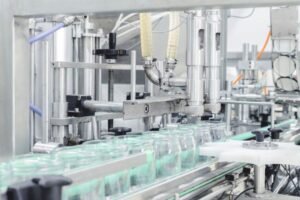
The process begins as jars are transported by a step-controlled conveyor belt and automatically positioned under the filling nozzle. Photoelectric sensors, like the EZPIC from Tri-Tronics, detect the presence and alignment of each jar, while laser distance sensors such as the LAR model from Waycon verify that it is placed at the correct height before filling starts.
2. Filling Initiation with Dynamic Control
Once the jar is correctly aligned, the FATEK FBs-20MCR2-AC PLC, equipped with an FBs-4A2D analog I/O module, activates the dosing valve. During filling, an S-type load cell QSH02030 from FUTEK, paired with its voltage amplifier FSH03863, continuously measures the jar’s weight. When the target weight (e.g., 100.00 g ± 0.1 g) is achieved, the PLC automatically closes the valve—ensuring each jar is filled with exact precision.
3. Compensation and Correction Algorithms
The system features intelligent algorithms that dynamically compensate for variations in liquid density, vibrations, or valve response time. This allows the FATEK PLC to make real-time corrections without interrupting production, guaranteeing consistency across all batches.
4. Level Validation and Anomaly Detection
To prevent overflow, a capacitive sensor (model 814400 from Rechner) monitors the liquid level. If an overfill is detected, an alert is issued, and the affected jar is automatically diverted by a pneumatic system controlled by the PLC. This ensures process reliability and product integrity.
5. Complete Filling Record and Traceability
Each filling cycle is fully traceable. The system logs key data such as batch number, weight, filling time, and operator ID. This information is stored locally and synchronized with a cloud-based system, facilitating audits and compliance with GMP and FDA standards.
6. Supervision and Manual Adjustments 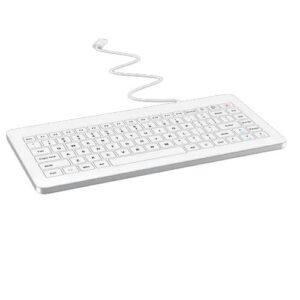
Operators can easily monitor and adjust parameters using the FATEK P5070SB HMI or through a DAVO D-B45 industrial keyboard, specially designed for sterile environments. This allows for intuitive control while maintaining hygiene and operational safety.
Key Advantages of the Automated Filling System
-
High-Precision Dosing:
Thanks to FUTEK S-type load cells (LSB201 series), the system achieves milligram-level accuracy, reducing waste and ensuring compliance with pharmaceutical standards. -
Adaptability and Flexibility:
The FATEK HMI enables quick configuration for different jar volumes and liquid types, allowing manufacturers to switch between products with minimal downtime. -
Reduced Human Error:
Automation minimizes the risks associated with manual filling, such as inconsistent dosing and contamination. -
Full Traceability:
Every jar is digitally documented, streamlining batch audits and ensuring regulatory compliance. -
Scalable and Modular Design:
Its PLC-based modular architecture allows the system to scale easily—supporting multiple filling lines or higher throughput as production grows. -
Seamless Industrial Connectivity:
With support for Modbus TCP/IP and MQTT, the system integrates effortlessly into SCADA, MES, or predictive analytics platforms, enhancing data visibility and operational efficiency.
Conclusion
The Sterile Jar Filling Automation System delivers a powerful combination of precision, reliability, and traceability, setting a new benchmark for sterile production environments. By leveraging FATEK PLCs, FUTEK sensors, and Tri-Tronics detection systems, manufacturers can achieve consistent quality, reduce waste, and maintain the highest hygiene standards across every batch.




sales@logicbus.com | support@logicbus.com | +1 619 616 7350 | Start conversation