


Modern aircraft rely on highly complex electronic systems to ensure safe navigation, accurate communication, and real-time data exchange between flight computers. Avionics testing and signal diagnostics in the cockpit play a critical role in verifying that these systems operate flawlessly—both during scheduled maintenance and troubleshooting of intermittent faults.
From navigation instruments to radar and onboard communication networks, technicians must validate that signals are transmitted cleanly, accurately, and without interference. This process demands precise test equipment and rugged peripherals designed for demanding aviation environments.
How Avionics Testing Works
Data Bus Analysis for Reliable Communication 
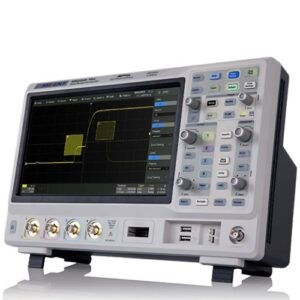
Aircraft avionics systems depend on multiple communication protocols to exchange mission-critical data. To verify signal integrity, technicians connect an SDS2104X Plus Oscilloscope equipped with advanced protocol decoding—such as CAN, LIN, and ARINC 429—directly to avionics test ports.
This allows engineers to visualize and decode navigation messages in real time, ensuring data is transmitted without noise, timing errors, or corruption. By analyzing waveforms and protocol frames simultaneously, even subtle communication issues can be identified before they impact flight performance.
Sensor Simulation Without Engine Start-Up
Testing cockpit indicators often requires simulating real operating conditions—without powering up engines or placing the aircraft in active operation. This is achieved using a SDG1062X Function Generator combined with an SPD3303X Programmable Power Supply.
Together, these instruments inject controlled electrical signals that replicate parameters such as airspeed, altitude, or oil temperature. This approach enables technicians to verify the accuracy of cockpit displays, warning systems, and sensor responses safely and efficiently inside the hangar.
Rugged Interaction in Hangar Environments
Avionics testing rarely takes place in clean laboratory conditions. Maintenance teams frequently work on mobile benches, inside tight cockpit spaces, or even on aircraft wings. For reliable interaction with diagnostic systems, technicians use the D-8605 Industrial Keyboard with Trackball.
Designed to withstand drops, grease, dust, and constant handling, this industrial-grade peripheral ensures dependable control of test equipment in harsh maintenance environments—where standard office keyboards would quickly fail.
Key Advantages of This Testing Approach
-
Accurate diagnosis of intermittent and complex electronic faults, reducing troubleshooting time
-
Portable, high-performance test equipment, ideal for both hangar and flight-line operations
-
Industrial peripherals engineered for durability, ensuring reliability in demanding aerospace maintenance conditions
Conclusion
Effective avionics testing and signal diagnostics are essential for maintaining aircraft safety, reliability, and regulatory compliance. By combining advanced oscilloscopes, signal generation tools, and rugged human-machine interfaces, maintenance teams gain the precision and resilience needed to keep cockpit systems operating at peak performance—no matter how challenging the environment.




sales@logicbus.com | support@logicbus.com | +1 619 616 7350 | Start conversation