

1. Introduction: Why Sterilization is Critical in Pharma and Food
In pharmaceutical manufacturing and food processing, thermal sterilization is a critical control point (CCP) that directly impacts product safety and public health. The objective is to achieve a Sterility Assurance Level (SAL) of $10^{-6}$, ensuring a one-in-a-million chance of microbial survival.
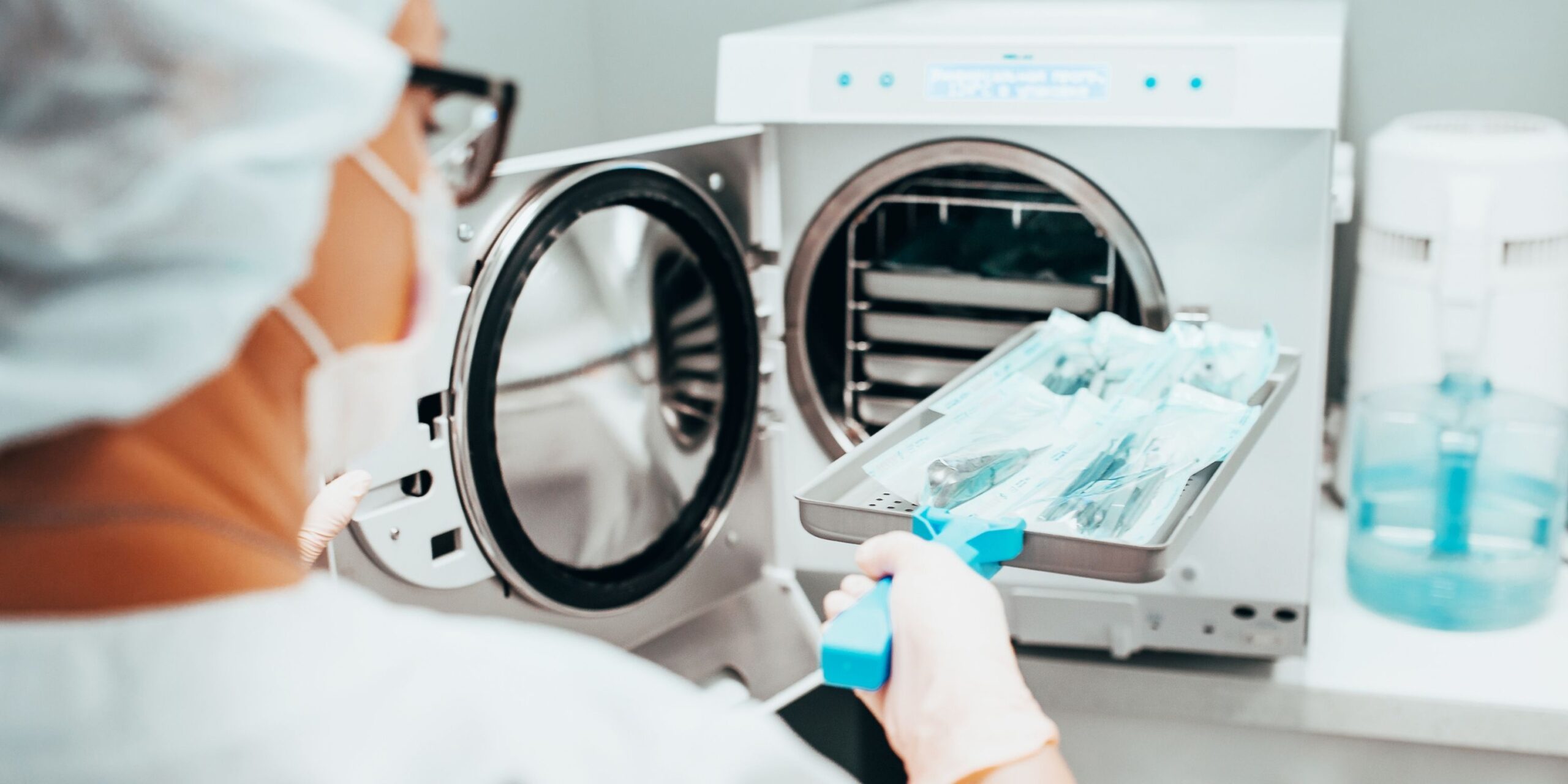
Autoclaves use saturated steam under pressure to destroy resilient bacterial spores like Geobacillus stearothermophilus. Saturated steam transfer is highly efficient, but its efficacy depends on thermodynamic uniformity. Several factors can compromise this environment:
-
Air Pockets: Act as insulators, preventing steam from contacting product surfaces.
-
Superheated Steam: Behaves like dry heat, drastically increasing the required microbial kill time.
-
Cold Spots: Physical regions inside the chamber or dense loads where temperature lags behind the set point.
Because validation engineers cannot rely solely on an autoclave’s built-in sensors, deploying independent data logger high temperature systems is mandatory to map the internal thermal topography and verify process lethality.
2. Regulatory Requirements: FDA 21 CFR, cGMP, ISO 11135, HTM 01-01
Compliance with international validation frameworks is required to achieve market clearance for pharmaceutical products.
FDA 21 CFR Part 11 and cGMP
Under Current Good Manufacturing Practices (cGMP), autoclaves require Installation Qualification (IQ), Operational Qualification (OQ), and Performance Qualification (PQ). Any digital asset used during PQ must comply with FDA 21 CFR Part 11. This mandates that validation software maintains an unalterable, cryptographically secured audit trail to verify that raw data has not been manipulated.
ISO 17665 and ISO 11135
-
ISO 17665: The primary standard for moist heat sterilization, requiring proof of steam penetration and temperature uniformity throughout the load.
-
ISO 11135: Governs ethylene oxide sterilization, establishing parallel principles for sensor placement, data integrity, and calibration traceability.
HTM 01-01 (Health Technical Memorandum)
Mainly applied in the UK and Europe, this framework enforces rigid guidelines for porous load and fluid sterilizers, demanding precise calculations of thermal lethality bands during the cycle holding phase.
3. HiTemp140: Specifications and Probe Configurations
The HiTemp140 autoclave logger is a submersible, 316 stainless steel instrument designed to withstand harsh sterilization environments without external thermal shields.
Technical Specifications
-
Operating Range (Body): -40°C to +140°C
-
Accuracy: $\pm0.1^\circ\text{C}$ from +20°C to +140°C
-
Memory Capacity: 65,536 readings (Non-volatile)
-
Enclosure Rating: IP68
Probe Configurations for Specialized Mapping
-
Rigid Probes (HiTemp140-1, -2, -5, -7): Ideal for open-air chamber mapping, drain lines, and empty-chamber OQ cycles.
-
Flexible RTD Probes (HiTemp140-PT): Equipped with a stainless steel braided or PFA-insulated cable. Essential for penetrating narrow-neck glass vials, stoppers, or tortuous fluid paths.
-
Dual Probes (HiTemp140-2D-PT): Features a combination of a rigid and a flexible sensor, allowing engineers to measure ambient steam and product core temperature simultaneously with one device.
4. PR140: Measuring Pressure in Sterilization Cycles 
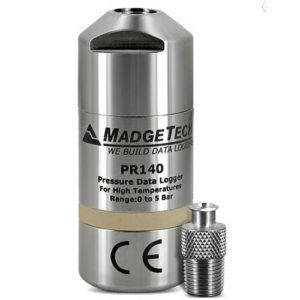
Temperature monitoring alone is insufficient. Saturated steam exhibits a fixed, mathematically predictable temperature-to-pressure relationship. The PR140 pressure logger helps diagnose deviations from this equilibrium.
Technical Specifications
-
Sensor Type: Piezoresistive pressure sensor
-
Pressure Range: 0 to 5 bar absolute (0 to 72.5 psia)
-
Accuracy: $\pm0.03 \text{ bar}$ ($\pm0.435 \text{ psi}$) at sterilization temperatures
Detecting Non-Condensable Gases (NCGs)
If air remains trapped in the chamber due to a faulty pre-vacuum pulse or a door gasket leak, it creates an air pocket. While temperature loggers might read 121°C due to ambient radiant heat, the air pocket prevents proper steam condensation. By deploying the PR140 alongside the HiTemp140, the software cross-references actual pressure against the saturated steam curve. A higher absolute pressure than the theoretical thermal equivalent confirms the presence of NCGs, indicating a cycle failure.
5. How to Configure Devices for a Validation Study
An audit-ready validation profile requires systematic hardware configuration:
-
Docking and Diagnostics: Insert loggers into the IFC400 single-docking station or the IFC406 multi-position cradle connected via USB. Check battery status before launch.
-
Clock Synchronization: Synchronize all loggers to the master workstation clock. This ensures precise point-to-point data alignment between temperature and pressure readings.
-
Sampling Interval: Set a sampling rate between 1 and 5 seconds to capture transient temperature drops or pressure spikes.
-
Placement: Distribute loggers across the chamber corners, center, and fluid load cores. Always place at least one logger near the chamber drain (the typical cold spot).
6. MadgeTech 4 Software: Automated Lethality and Reports
The MadgeTech 4 Secure Software streamlines data analysis, turning binary logs into regulatory documentation.
Automated $F_0$ Calculations
The software automatically calculates the accumulation of microbial lethality ($F_0$) based on the standard reference temperature of 121.1°C and a $z$-value of 10°C, using the following equation:
This eliminates manual spreadsheet computations, tracking the accumulated lethal dose for each sensor channel in real time.
Graphing and Compliance Output
Engineers can overlay temperature profiles from multiple HiTemp140 units with the PR140 pressure curve. The software isolates specific cycle phases (Pre-vacuum, Exposure, Exhaust) and generates secure, non-editable PDF reports featuring integrated pass/fail metrics and an automated electronic audit trail.
7. Common Errors in Autoclave Validation
Avoiding standard operational pitfalls is critical for successful qualification:
-
Ignoring Liquid Thermal Lag: Placing loggers outside of container fluid paths rather than inserting them directly into the core fluid mass leads to overestimating the real $F_0$ value.
-
Skipping Pressure Verification: Relying only on temperature sensors misses localized stratification caused by non-condensable gases (NCGs).
-
Poor Clock Alignment: Misaligned logger clocks generate skewed steam saturation calculations during fast pressure transitions.
-
Neglecting Post-Run Verification: Failing to perform pre- and post-validation calibration loops can invalidate an entire qualification dataset if an auditor requests sensor traceability.
8. Case Study: Pharmaceutical Bio-Manufacturing Plant
Challenge
A pharmaceutical plant in Mexico conducted its annual Performance Qualification (PQ) on a floor-loading production autoclave. The load consisted of dense trays filled with 500 mL borosilicate glass vials. The criteria required a sterilization cycle of 121.0°C for 15 minutes, with an accumulated $F_0 \ge 15.0$ minutes inside every vial.
Solution & Analysis
The validation team deployed 12 HiTemp140 autoclave loggers and 2 PR140 pressure units. Six flexible HiTemp140-PT probes were routed through stoppers into the geometric center of the fluid vials.
The initial data download revealed a 4.5-minute thermal lag for the liquid core to reach 121.0°C relative to the ambient chamber steam. Consequently, the internal vial loggers only accumulated an $F_0$ value of 11.2 minutes, resulting in an initial cycle failure. The PR140 data matched the saturated steam curve, confirming excellent steam quality and ruling out NCGs.
Resolution
Using this empirical data, the engineering team extended the autoclave exposure phase by 5 minutes to compensate for the liquid thermal lag. A secondary validation run confirmed that all internal liquid sensors achieved an $F_0 \ge 16.5$ minutes, fulfilling the cGMP audit criteria and securing system qualification.
9. CTA Logicbus USA
Achieving compliant, reliable thermal processes requires high-precision instrumentation. Logicbus is an authorized distributor of MadgeTech solutions, providing hardware, compliant software packages, and professional calibration services.
-
Explore our complete catalog on logicbus.com
-
Request a technical quote for the MadgeTech HiTemp140 series.
-
Contact an applications engineer today to select the ideal probe configuration and validation accessories for your specific application.




sales@logicbus.com | support@logicbus.com | +1 619 616 7350 | Start conversation