


Water leak detection plays a crucial role in preventing costly damage, equipment downtime, and safety hazards. Choosing the right type of sensor—point or rope—can make the difference between quick containment and unnoticed damage. In this article, we’ll compare both technologies to help you identify which one best suits your application.
What Are Point Type Water Leak Sensors?
Point type water leak sensors detect the presence of water at a specific location. They usually include two conductive contacts positioned close to the floor. When water bridges these contacts, the sensor instantly sends a signal to trigger an alarm or system response.
Key Advantages and Typical Applications
-
Easy installation: simply place the sensor beneath equipment or in areas prone to leaks.
-
Minimal maintenance: no cables or long runs to inspect.
-
Cost-effective solution: ideal for localized monitoring points.
-
Immediate detection: activates as soon as water reaches the sensor.
-
Flexible use: effective under sinks, near pumps, HVAC units, or beneath raised floors.
Controller compatibility:
Point sensors generally provide relay outputs (dry contact) or open collector signals, allowing seamless integration with PLCs, alarm systems, monitoring software, or building management systems (BMS).
Example: 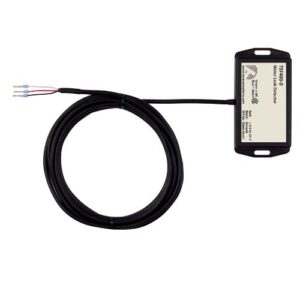
The TSF400 Point Water Leak Detector is compatible with Modbus RTU and any controller supporting dry contact inputs, offering precise and reliable detection for industrial and commercial environments.
What Are Rope Type Water Leak Sensors?
Rope type sensors, also known as leak detection cables, can identify water presence anywhere along the length of a sensing cable. These cables can be laid out under raised floors, around racks, or alongside pipelines to detect leaks over a wide area.
Main Benefits and Ideal Use Cases
-
Extensive coverage: one cable can monitor several meters or even entire rooms.
-
Flexible routing: easily fits around walls, machinery, or complex layouts.
-
Scalable system: cables can be extended or connected for large facilities.
-
Distributed sensing: detects water wherever it first appears along the cable.
-
Critical protection: perfect for data centers, telecom facilities, and industrial plants.
Controller compatibility:
Rope sensors typically require dedicated controllers that can not only detect water presence but also identify cable faults or even pinpoint the exact leak location.
Point vs. Rope: Understanding the Key Differences
| Feature | Point Type Sensor | Rope Type Sensor |
|---|---|---|
| Coverage | Detects at a single location | Detects along the cable length |
| Installation | Simple, compact, low cost | Requires longer cable runs and controllers |
| Maintenance | Minimal | Regular cable inspection recommended |
| Response Time | Instant at contact point | Instant at any point along the cable |
| Ideal Use | Small, localized areas | Large or mission-critical zones |
In short, point sensors are perfect for monitoring small or isolated risk points, while rope sensors are better for continuous monitoring across larger areas.
Combining Point and Rope Sensors for Maximum Protection
Many facilities achieve optimal protection by combining both sensor types:
-
Point sensors: placed under valves, pumps, or cooling units.
-
Rope sensors: installed under raised floors, along walls, or near pipelines.
This hybrid approach ensures comprehensive coverage—detecting localized leaks and large-area incidents alike—offering the most reliable and cost-effective water leak detection strategy.
Conclusion: Selecting the Best Water Leak Sensor for Your Application
Choosing between point and rope water leak sensors depends on your facility’s layout and the criticality of your operations.
-
Point sensors: simple, affordable, and easy to integrate with existing controllers.
-
Rope sensors: ideal for large areas, requiring specialized detection systems.
-
Hybrid setups: combine both for the highest level of reliability and protection.
By implementing the right leak detection strategy, you safeguard your infrastructure, minimize downtime, and maintain operational continuity—essential goals for any industrial, commercial, or data-driven environment.




sales@logicbus.com | support@logicbus.com | +1 619 616 7350 | Start conversation