


In the beverage and liquid packaging industry, operations move at a blistering pace, often processing hundreds or even thousands of bottles per minute. At these velocities, manual inspection is impossible, and standard automation systems face extreme latency challenges. A single missing label, an unsealed cap, or a conveyor jam can ruin entire pallets, cause massive product recalls, or damage downstream machinery if not detected in a fraction of a second.
Securing total quality control at high speeds requires a closed-loop system where detection, spatial tracking, and edge processing operate in perfect synchrony.
Architecture of a High-Speed Inspection System
To achieve flawless packaging without sacrificing throughput, the system architecture must link high-frequency optical sensing directly with precise mechanical tracking and localized computing.
1. High-Speed Detection: Tri-Tronics PZRCR4 Sensors 
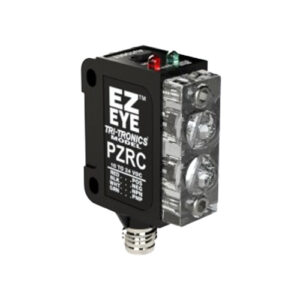
The first line of defense is real-time optical verification. Standard photoelectric sensors often lack the response time required for fast-moving targets, leading to blurred signals or missed triggers. The implementation of high-speed sensors, such as the Tri-Tronics PZRCR4, addresses this gap.
-
Multi-Point Verification: Mounted at strategic points along the conveyor, these fast-response photoelectric sensors are tuned to verify multiple criteria simultaneously: bottle presence, precise label placement, and the exact height or tilt of the cap to confirm closure.
-
Low Latency: Their exceptional switching frequency ensures that even at maximum conveyor speeds, the sensor registers every gap and feature without signal degradation.
2. Conveyor Synchronization: Tri-Tronics RH-P Wheel Encoders
Detecting a defect is only half the battle. In a continuous motion line, the system must know where that defective bottle is as it travels toward the rejection station. This is where synchronization becomes critical.
By utilizing wheel encoders like the Tri-Tronics RH-P series, the system tracks the exact linear displacement of the conveyor belt.
-
Micro-Millisecond Tracking: The encoder translates the physical movement of the belt into a precise pulse stream.
-
Dynamic FIFO Mapping: When the PZRCR4 sensor detects a bad cap, the system tags that specific bottle in a FIFO (First-In, First-Out) memory stack. By counting the encoder pulses, the control logic knows the exact millisecond the defective unit arrives at the pneumatic rejector, ensuring highly targeted removal without disturbing adjacent, good products.
3. Real-Time Edge Processing: TBOX-3D30D Industrial Computer
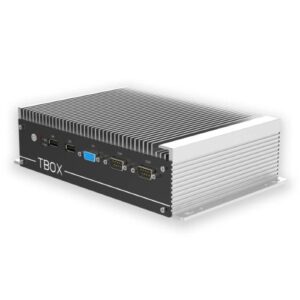
The massive influx of high-frequency digital signals from the sensors and encoders demands a dedicated processing hub capable of executing complex sorting algorithms without latency.
Integrating a rugged industrial computer like the TBOX-3D30D allows the line to perform edge processing directly at the machine level.
-
Deterministic Logic Execution: The computer processes the raw I/O data from the sensors and high-speed encoder counters in real time, bypassing the overhead latencies sometimes associated with centralized factory ERPs.
-
Actuator Control: Upon calculating the exact position, the computer triggers a precise electrical signal to a pneumatic rejector, kicking the defective bottle into a holding bin.
Operational Advantages in Hostile Environments
Deploying this specialized automation stack provides critical advantages to beverage packaging operations:
-
Maximized OEE without Quality Compromises: Facilities can run their filling and capping machines at full mechanical capacity, knowing that inspection integrity remains at 100%.
-
Consumer and Brand Protection: Preventing unsealed or mislabeled beverages from leaving the dock protects the brand from costly compliance penalties and preserves consumer safety.
-
Industrial Resilience: Bottling plants are notoriously harsh environments characterized by heavy vibration and constant moisture from washdown procedures. Utilizing industrial-grade components, such as those available through automation distributors like Logicbus, ensures that the networking, computing, and sensing hardware maintain MTBF (Mean Time Between Failures) targets despite these stressors.
Conclusion
High-speed bottling line synchronization represents the intersection of precision optics, motion tracking, and edge computing. By shifting from reactive, post-process checking to inline, millisecond-accurate tracking, beverage manufacturers can eliminate scrap, secure their supply chain, and guarantee that every unit leaving the facility meets the highest standard of quality.




sales@logicbus.com | support@logicbus.com | +1 619 616 7350 | Start conversation