

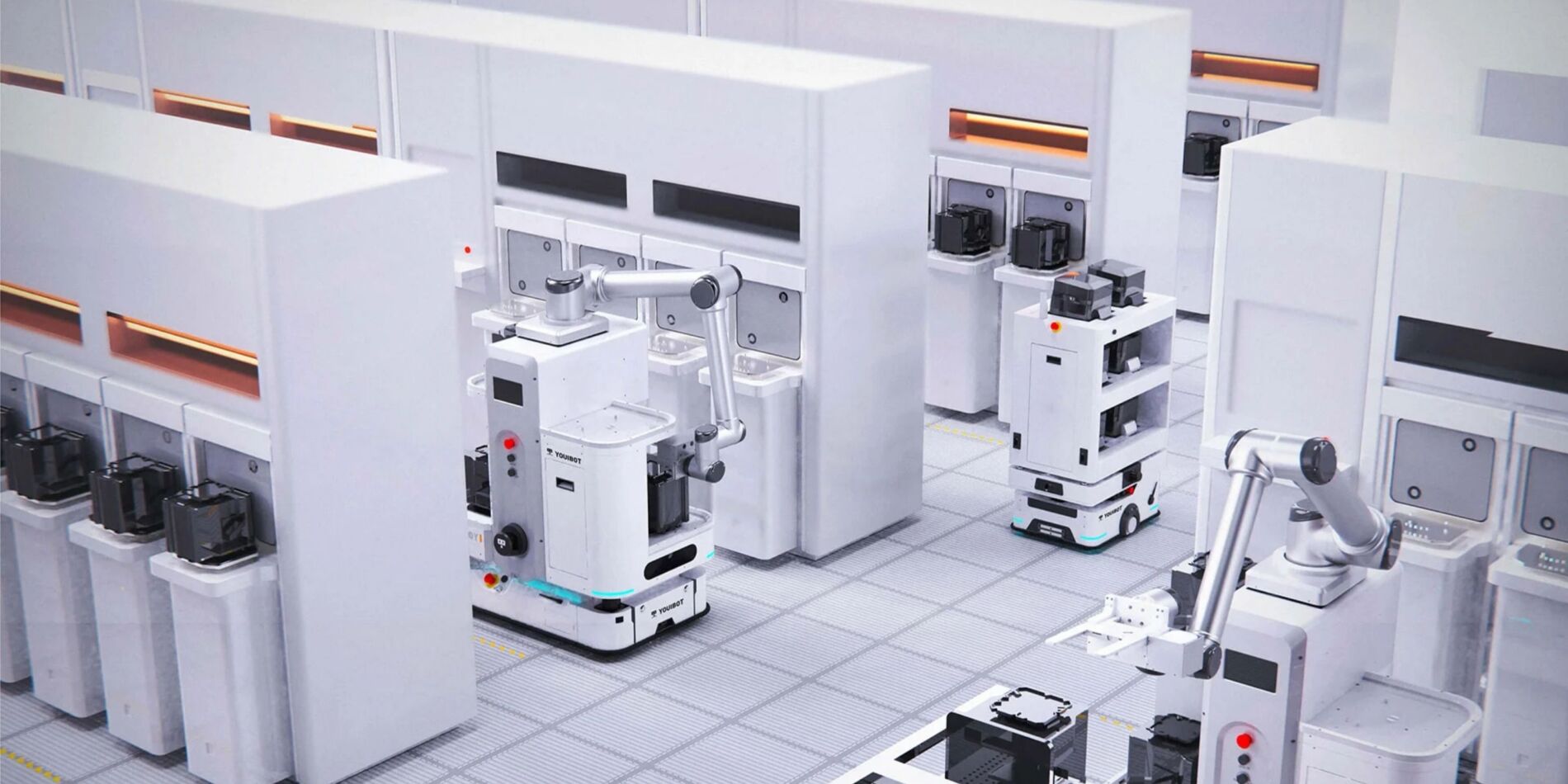
Manual wafer transport in semiconductor fabs introduces particulate contamination, mechanical vibration, and routing delays that directly degrade wafer yield. As semiconductor manufacturing scales to smaller nanometer nodes, the margin for human error in handling Front Opening Unified Pods (FOUPs) between processing tools disappears. Relying on technicians to push carts through sterile environments creates unavoidable bottlenecks and increases the baseline particle count in the cleanroom.
Autonomous Navigation in ISO Cleanrooms
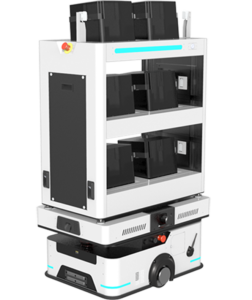
To maintain strict contamination control, facilities are deploying Youibot Autonomous Mobile Robots (AMRs) to automate intralogistics. These robotic platforms eliminate human-induced particle generation by executing fully autonomous material transfers.
Equipped with LiDAR and SLAM (Simultaneous Localization and Mapping) navigation, Youibot AMRs map complex fab layouts dynamically. They bypass obstacles, adjust routes in real-time, and dock with processing equipment with sub-millimeter precision. Because they do not rely on magnetic tape or QR code grids, facility engineers can reprogram traffic flows instantly when adding new lithography or etching tools to the floor.
Real-Time IoT Data and Fleet Analytics
Automated movement is only part of the architecture. Youibot integrates IoT telemetry into the fleet control system, providing plant managers with continuous data on material flow. The software tracks every FOUP’s location, monitors battery states, and analyzes production metrics. This real-time visibility prevents WIP (Work in Progress) from bottlenecking at metrology stations and allows the system to reroute robots automatically if a specific aisle experiences congestion.
Energy Efficiency and Fab Sustainability
High-volume manufacturing requires massive energy expenditure. Youibot AMRs optimize routing to minimize idle time and travel distance, directly reducing the power consumption of the logistics fleet. By running continuous, optimized loops and managing charge cycles autonomously, the robots support facility-wide carbon footprint reduction while maintaining 24/7 material flow.
Industrial Application Scenarios
-
Wafer Fab Transport (FOUP/SMIF): Safe, vibration-dampened transfer of 300 mm and 200 mm wafers between lithography, etching, and metrology bays. The robotic chassis absorbs floor vibrations, preventing micro-fractures in the silicon structures.
-
Reticle Storage Logistics: Automated retrieval and delivery of reticles from the stocker to the scanner, ensuring the right mask is delivered precisely when the tool requests it, eliminating idle machine time.
-
Consumables and Waste Handling: Autonomous delivery of cleanroom garments, test wafers, and chemical containers to point-of-use locations, keeping technicians at their stations instead of acting as material runners.
Technical Comparison: Manual vs. AMR Intralogistics
| Specification / Metric | Manual Cleanroom Transport | Youibot AMR Integration |
| Contamination Risk | High (Human particle shedding) | Minimal (ISO Class 3/4 compatible) |
| Vibration Control | Unpredictable (Cart bumping) | Active dampening suspension |
| Routing / Navigation | Fixed human pathways | Dynamic SLAM navigation |
| Data Visibility | Manual barcode scanning at tools | Continuous IoT telemetry & tracking |
| Fleet Scalability | Requires hiring and training shifts | Software-based fleet expansion |
| System Uptime | Subject to shift changes / fatigue | 24/7 operation with auto-charging |
Upgrading fab intralogistics requires strict adherence to cleanroom protocols and precise mapping of AMR fleet traffic. For application support, payload specification, and integration of Youibot robotic solutions in your facility, contact the engineering team at www.logicbus.com to consult directly with an automation specialist for North America.




sales@logicbus.com | support@logicbus.com | +1 619 616 7350 | Start conversation