

The convergence of telemetry, onboard video, and Train Control and Monitoring Systems (TCMS) onto a single digital railway infrastructure creates a critical structural vulnerability. If a single communication link fails in a standard topology, safety-critical control traffic drops instantly. While compliance with ITxPT and IEC 61375 standards ensures multi-vendor interoperability, it does not guarantee operational continuity when a network switch or cable physically fails in transit.
Where Convergence Fails in Standard Networks
Public transport fleets combine hardware from multiple suppliers. Without an open, industrial-grade switching backbone, vehicle-to-ground communication degrades into a patchwork of proprietary links lacking automatic fallback mechanisms.
The issue compounds at the data processing level. Standard best-effort networking treats all traffic equally under high load. In a railway environment, routing a traction or braking command behind an HD security video stream is an unacceptable operating condition. Without a deterministic scheduling layer, being physically connected does not mean data arrives on time.
TSN Architecture and Dual Backbones
To prevent the isolation of critical subsystems during dynamic coupling and recoupling of train cars, the network requires a dual backbone structured with dual-homed terminals. Under this architecture, no single path failure can disconnect a section of the train. When a new unit couples, the network discovers the devices and updates its topology in milliseconds without operator intervention.
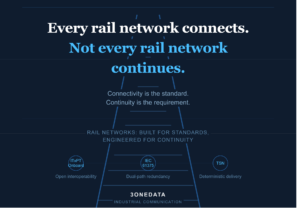
To resolve latency in converged traffic, TSN (Time-Sensitive Networking) switches enforce strict data prioritization. Control signals, video, and telemetry coexist on the same physical wire, but TSN scheduling guarantees that priority commands are never queued behind secondary data. This enables:
-
Time synchronization: Nanosecond-level precision across the entire train formation.
-
Response speed: Millisecond-range latency for direct control actions.
Industrial Rolling Stock Applications
-
High-Speed Rail (EMU & Maglev): Communication networks deployed on 600 km/h maglev projects and dynamic train formations where automatic topology discovery prevents central monitoring system crashes.
-
Urban Light Rail and Metro: Implementation of ITxPT-certified onboard and trackside networks to unify vehicle-to-depot communication without relying on closed, single-vendor ecosystems.
-
Cross-Border Rail Corridors: Mission-critical infrastructures demanding native redundancy to keep signaling functions operational across hundreds of miles.
Technical Comparison: Standard vs. Deterministic Networks
| Technical Parameter | Standard Converged Network | Deterministic Architecture (TSN) |
| Network Topology | Single backbone | Dual backbone with dual-homed terminals |
| Packet Prioritization | Standard Quality of Service (QoS) | Strict TSN scheduling |
| Time Synchronization | Millisecond range | Nanosecond precision |
| Coupling Recovery | Manual or high latency | Automatic topology update (milliseconds) |
| Base Standards | Conventional TCP/IP | IEC 61375, ITxPT, IEEE 802.1 |
| Physical Fault Tolerance | Vulnerable (Single point of failure) | High availability (No single points of failure) |
Railway assets operate for decades. Designing a network based solely on current bandwidth requirements forces highly expensive corrective interventions in the future. Integrating fault-tolerant topologies ensures that safety-critical systems always reach their logical destination, regardless of hardware conditions.
To integrate railway-compliant industrial switches, TSN architectures, and 3onedata equipment into your projects, contact the application engineering team at www.logicbus.com for technical consulting and hardware sizing in North America.




sales@logicbus.com | support@logicbus.com | +1 619 616 7350 | Start conversation