

In industrial automation and quality control, non-contact infrared temperature measurement (pyrometry) is a standard practice. However, when an application requires measuring extremely small targets, technical complexity increases significantly.
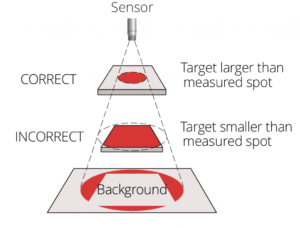
If an infrared sensor’s measured spot size is larger than the target object, the sensor collects thermal radiation from the surrounding background, producing inaccurate readings that compromise process control.
The Core Rule: Target Size vs. Measured Spot Size
To ensure maximum measurement accuracy, the golden rule in infrared pyrometry states that the measured spot size should be half the target size or smaller.
-
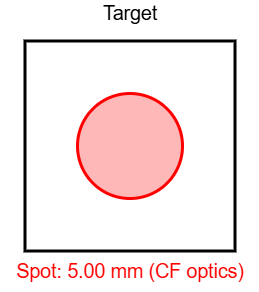
Practical Example: For a target diameter of 10 mm, the sensor’s measured spot size at the focal distance must be 5 mm or smaller.
Optical Solutions: Close-Focus vs. Specialized Sensors
1. Close-Focus Optics
Most standard industrial infrared sensors offer close-focus optical options designed for mounting close to the target object.
-
Standard close-focus optics typically achieve a minimum spot size of approximately 5 mm.
-
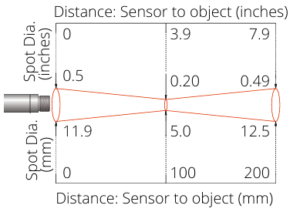
Consult the optical diagrams in the product datasheet to determine the exact mounting distance required to achieve the smallest spot size.
2. Specialized Micro-Target Sensors: PyroCube & FibreCube
When the target object is smaller than 5 mm, standard close-focus optics are no longer sufficient. Specialized high-performance sensors are required:
-
PyroCube S (Model PCU-S1.6): Measures an ultra-small spot size down to 1.6 mm in diameter.
-
PyroCube XS: Delivers market-leading optical resolution, measuring spot sizes as small as 0.7 mm.
Sensor Option Comparison
| Sensor Solution | Minimum Spot Size | Primary Target Application |
| Standard Close-Focus IR Sensor | ~ 5.0 mm | Medium industrial components at short distances. |
| PyroCube S (Model PCU-S1.6) | 1.6 mm | Electrical conductors, component pins, motor rotor testing. |
| PyroCube XS | 0.7 mm | SMD electronic components, microchips, fine wires. |
Key Industrial Applications
1. Electric Motor Rotor Temperature Measurement (EV R&D)
As electric vehicle (EV) R&D accelerates, motor manufacturers are pushing power density limits. Measuring the temperature of moving internal components on test rigs remains a critical engineering challenge.
-
The Solution: Using the PyroCube PCU-S1.6, engineers can measure rotor temperature through a small access hole in the stator or housing.
-
Rapid Response: The sensor’s fast response time captures precise thermal profiles during high-speed testing, even during rapid temperature spikes.
-
Technical Considerations:
-
If the rotor surface is reflective bare metal or copper windings are exposed, coat the target area with high-emissivity paint to ensure accurate readings.
-
The stator access hole must be at least twice the size of the sensor’s field of view (FOV) to prevent ambient stator temperatures from corrupting the rotor measurement.
-
2. Component Temperature in PCB Manufacturing
Circuit board manufacturers must verify electronic component temperatures under real-world load conditions:
-
Power & Voltage Testing: When the board is powered, individual surface-mount devices (SMDs) and integrated circuits (ICs) are measured quickly and accurately, aided by the PyroCube’s ultra-small spot size and built-in LED aiming light.
-
Thermal Chamber Testing: Verifies surface temperature profiles during ambient operating limit tests.
3. Electrical Wire and Cable Manufacturing
During plastic insulation extrusion, copper wire passes through an extruder and is immediately flame-polished by an automated burner to smooth the outer jacket.
-
Closed-Loop PID Control: The polishing flame is dynamically controlled by measuring the temperature of the newly applied insulation with a PyroCube sensor, feeding the output signal directly into a PID controller or PLC.
-
Fine Diameter Precision: The small spot size allows precise measurement on insulation diameters of 1.6 mm or larger, while the built-in LED aim light ensures effortless alignment on fast-moving wire lines.
Technical Support & Pyrometry Consultation with Logicbus
Selecting the correct infrared optics requires balancing working distance, target emissivity, and spot size ratios.
At Logicbus, we provide industrial sensors, non-contact pyrometers, and data acquisition solutions tailored for demanding manufacturing and R&D applications across North America.
-
Need assistance selecting an infrared sensor for micro-targets or fast-moving components?
-
Contact our application engineering team today for technical support and product selection.
Explore Industrial Sensors at Logicbus.com




sales@logicbus.com | support@logicbus.com | +1 619 616 7350 | Start conversation