

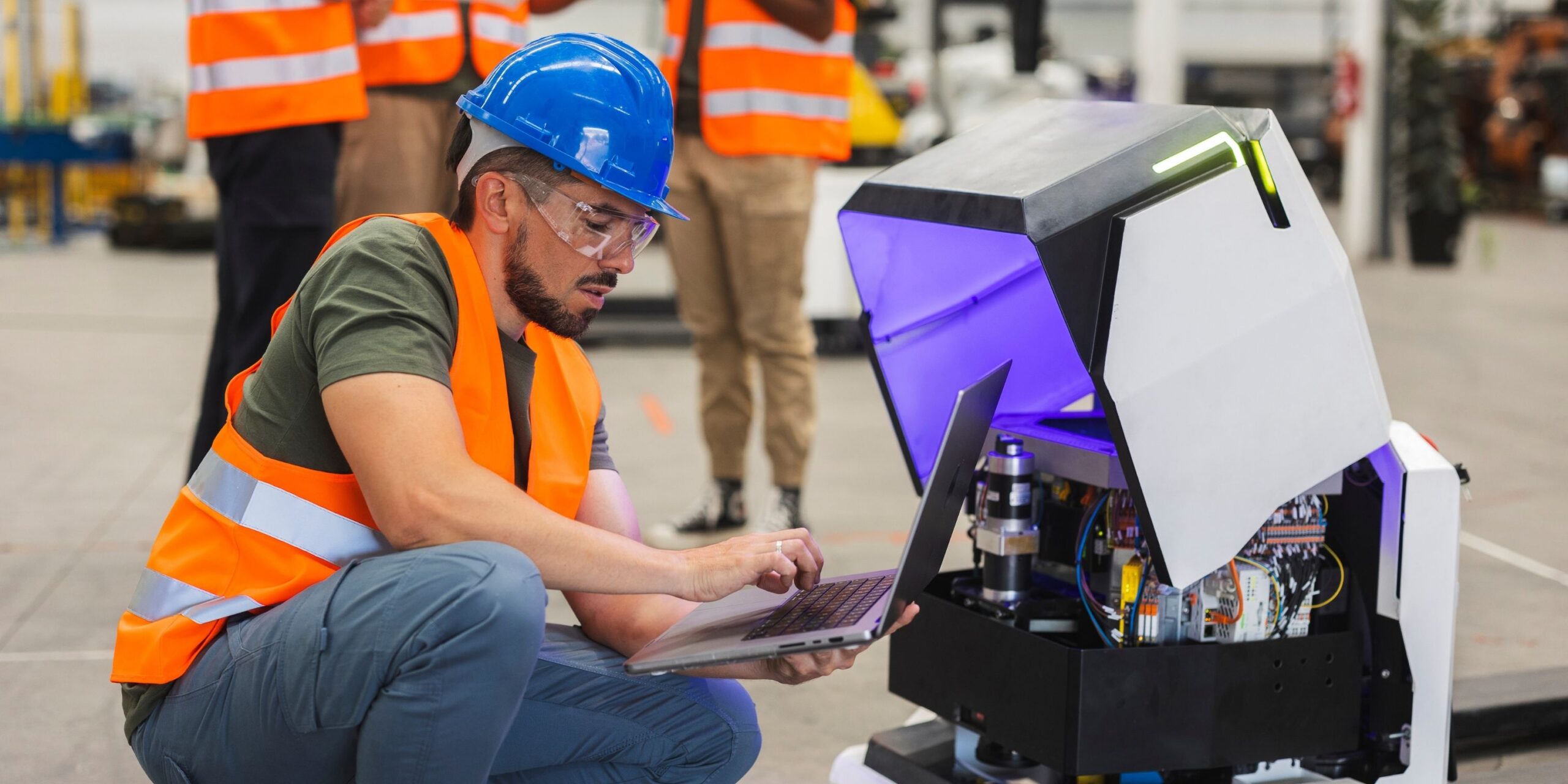
In industries that operate under strict hygiene and contamination control standards—such as pharmaceuticals, biotechnology, or high-precision manufacturing—the movement of materials between classified areas must comply with rigorous protocols. To address these challenges, Autonomous Mobile Robots (AMRs) are revolutionizing internal logistics by providing automated, traceable, and contamination-free transport across ISO 7/8 classified areas (GMP environments).
A New Era of Smart Material Transport
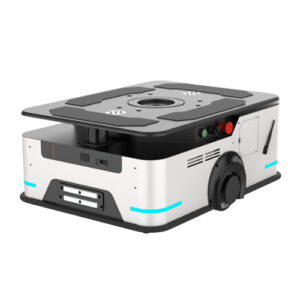
This solution uses Youibot’s L300 AMR, specifically designed for regulated environments with controlled airflow and cross-contamination restrictions. The system enables the fully automated transfer of materials—such as raw inputs, semi-finished batches, or finished products—between production, weighing, quarantine, and storage zones. The result is a seamless logistics operation without direct human intervention, ensuring full regulatory compliance, safety, and efficiency.
How It Works
1. Automated Transport Request 
Operators initiate a material transport task directly from an HMI station, which can be a TAICENN Panel PC or an Emdoor industrial tablet. Through this interface, the operator specifies the pickup and destination points—for example, moving a quarantined batch to a storage room.
The fleet management system then assigns the nearest available L300 AMR to execute the task, optimizing route efficiency and reducing waiting times.
2. Environmental Verification and Route Validation
Before departure, the L300 AMR performs environmental verification by ensuring that all doors are securely closed, temperature and particle sensors report normal parameters, and that no personnel or obstacles are in its path.
This pre-check guarantees safe navigation while maintaining cleanroom integrity.
3. Autonomous Transport Between Areas
Once validated, the AMR moves autonomously through the classified zones using LIDAR sensors, SLAM mapping, and advanced safety scanners. This technology allows it to dynamically adapt its route in real time, ensuring uninterrupted transport even in changing environments.
4. Load Identification and Confirmation
Each transported load is equipped with RFID or barcode tags, which are scanned by integrated readers on the L300 AMR. This process ensures complete traceability, confirming the batch number, order code, and exact timestamp of every movement within the facility.
5. Delivery and Event Recording
Upon reaching its destination, the AMR stops precisely at the designated unloading point. The material is automatically released via a lift or pneumatic mechanism, while the system updates the SCADA platform with all transport details—time, operator authorization, and environmental readings.
This guarantees real-time documentation and compliance with GMP traceability requirements.
6. Return and Self-Disinfection (Optional)
For operations requiring sterile conditions, the L300 AMR can automatically move to a disinfection station before returning to its base. This step aligns with cleanroom decontamination protocols, maintaining the integrity of high-grade environments.
Key Benefits
-
Full GMP and ISO cleanroom compliance
-
Minimized human contact, reducing contamination and safety risks
-
End-to-end traceability of materials and processes
-
Intelligent route optimization with real-time adaptation
-
Seamless integration with ERP, MES, SCADA, and access control systems
-
Increased logistics efficiency without manual transport vehicles
Conclusion
Implementing autonomous material transport between classified areas represents a significant leap toward smart, contamination-free, and traceable logistics. With solutions like Youibot’s L300 AMR, industries can maintain strict regulatory compliance while achieving new levels of productivity and operational safety.




sales@logicbus.com | support@logicbus.com | +1 619 616 7350 | Start conversation