

In the highly competitive landscape of industrial automation and modern manufacturing, plant profitability is intrinsically linked to asset availability. Every minute of unplanned downtime represents not just a direct loss of production, but also a negative impact on the supply chain and operating margins.
This week, we are diving into two Key Performance Indicators (KPIs) fundamental to reliability engineering: MTBF (Mean Time Between Failures) and MTTR (Mean Time To Repair). Understanding and optimizing these metrics is the first step in transitioning from a reactive maintenance approach to a strategy of sustainable operational excellence.
Understanding Reliability and Maintainability
To efficiently manage any production line, it is imperative to separate an equipment’s ability to operate smoothly (reliability) from the maintenance team’s ability to return it to an operational state after a failure (maintainability).
MTBF (Mean Time Between Failures)
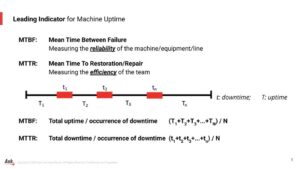
MTBF is the gold standard metric for reliability. It quantifies the average continuous time a system, machine, or component operates before experiencing a failure that interrupts its function.
Technically, MTBF is calculated by dividing the total operational time (uptime) by the number of failures during that period. A high MTBF is synonymous with robust design and highly dependable equipment. In practice, knowing the MTBF of a servomotor, a PLC, or a conveyor belt allows plant engineers to calculate failure probabilities and design preventive and predictive maintenance schedules, preventing the asset from reaching a point of breakdown.
MTTR (Mean Time To Restoration/Repair)
While MTBF measures machine reliability, MTTR measures the efficiency of the maintenance process. It represents the average time required to diagnose, repair, test, and return a failed system to its nominal operating status.
MTTR encompasses the entire failure cycle: from the moment an alert is triggered in the SCADA system, through root cause diagnosis and spare parts availability, down to the safe restart of the equipment. A low MTTR indicates agile maintenance processes, well-trained technicians, and optimized spare parts inventory management, translating to minimal disruptions in the production flow.
The Strategic Value: Why These Metrics Transform Operations
Monitoring these metrics in isolation does not generate value; the true competitive advantage arises when they are integrated into a Total Productive Maintenance (TPM) strategy and the calculation of Overall Equipment Effectiveness (OEE).
-
Proactive and Predictive Maintenance: An accurate historical record of MTBF allows you to abandon costly “fix it when it breaks” routines. By statistically predicting when a component is likely to fail, downtime can be scheduled strategically (Condition-Based Maintenance), replacing critical parts just before they end their useful lifecycle.
-
Drastic Downtime Reduction: Plant availability is a direct function of both MTBF and MTTR. By optimizing repair protocols, standardizing tools, and improving automated diagnostics, MTTR is compressed. This protects production schedules, ensures delivery commitments, and elevates the Availability factor within your OEE.
-
Total Cost of Ownership (TCO) Optimization: The combination of reliable equipment (high MTBF) and swift repairs (low MTTR) drastically lowers overall maintenance overhead. Overtime pay is reduced, raw material waste from sudden stops is minimized, and the lifespan of capital assets is extended.
Real-World Application: From Data to Profitability
To illustrate the tangible impact of these metrics, consider the case of a mid-sized manufacturer struggling with recurring downtime and bottlenecks on a critical automated assembly line.
Instead of simply reacting to each stoppage, the engineering team implemented a rigorous MTBF and MTTR analysis.
-
Increasing Reliability (MTBF): Through data analysis, they pinpointed that 60% of stoppages stemmed from premature wear on a specific mechanical component. By identifying the root cause, they redesigned the lubrication interval and improved the assembly alignment. This simple, data-driven modification increased the machine’s overall MTBF by 20%.
-
Streamlining Restoration (MTTR): Simultaneously, the team noticed that a significant portion of repair time was lost searching for spare parts in the warehouse and manually diagnosing the error. By implementing a modular spare parts kit next to the line and programming more specific diagnostic alarms in the HMI, they successfully cut MTTR by 10%.
The Result: Combining these two improvements did not require purchasing heavy new machinery, yet the operational impact was massive. The line experienced a 12% improvement in production throughput, alongside a substantial reduction in corrective maintenance costs.
This case demonstrates that MTBF and MTTR are not just numbers on a dashboard; they are strategic levers. When leveraged effectively, they become the primary engine for operational excellence and industrial profitability.




sales@logicbus.com | support@logicbus.com | +1 619 616 7350 | Start conversation