

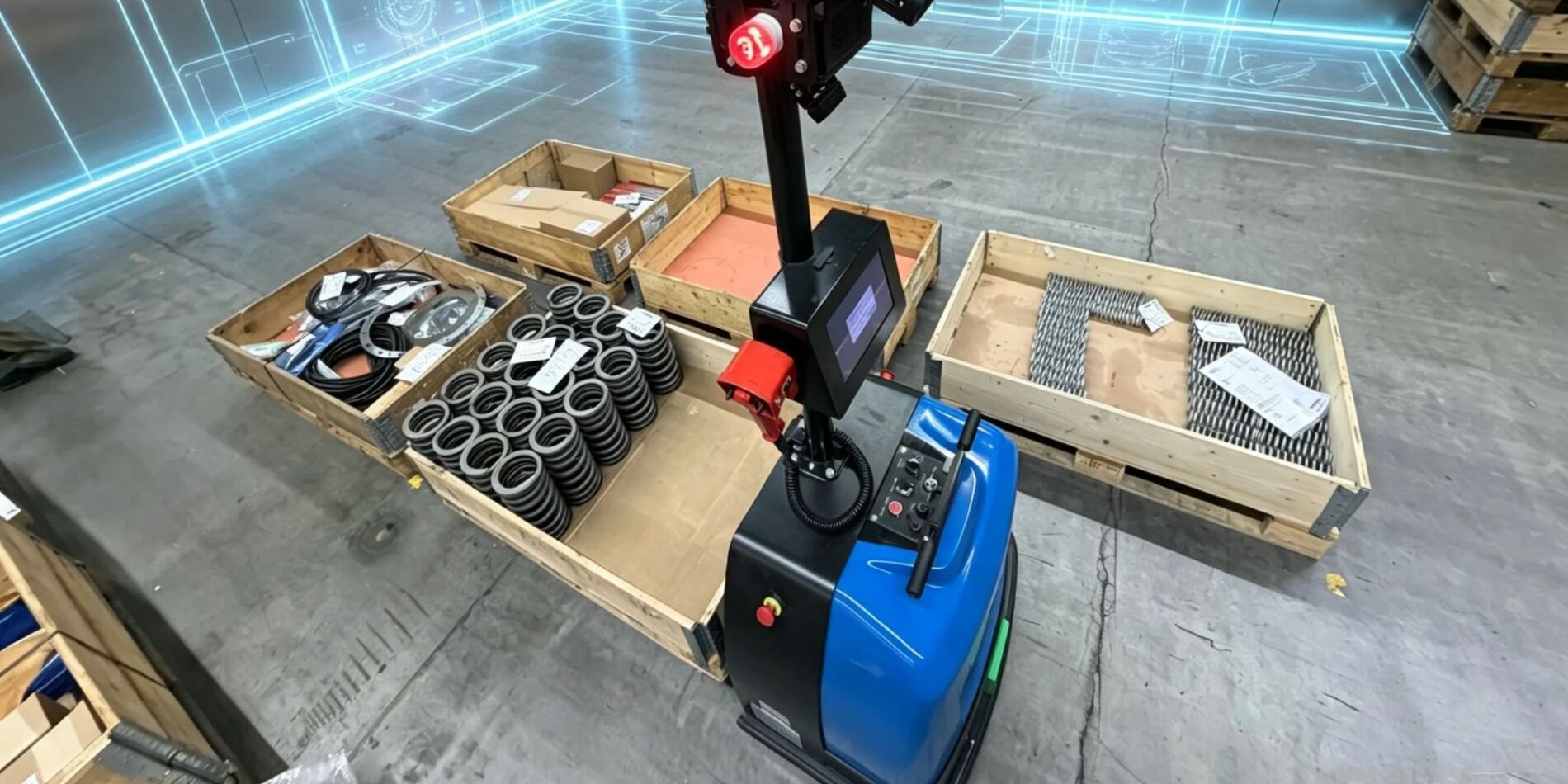
In the field of intelligent logistics, Autonomous Mobile Robots (AMRs) are rapidly replacing traditional Automated Guided Vehicles (AGVs) as the preferred choice for factory automation upgrades.
However, across manufacturing and warehousing sectors, many plant managers still wonder: What are the fundamental structural differences between these two technologies? And why can AutoXing’s autonomous forklifts and mobile platforms navigate seamlessly without magnetic strips, optical tape, or QR codes on the floor?
Below is a technical breakdown of the core knowledge points behind this generational leap in intelligent material handling.
01. Traditional AGVs vs. AutoXing AMRs: Three Key Dimensions
The gap between a conventional AGV and an AutoXing AMR is defined by three fundamental operational dimensions:
1. Navigation Method
-
Traditional AGV: Operates much like a train on fixed tracks. It requires the physical installation of magnetic strips, QR code grids, or optical reflectors across the facility floor. Its movement is strictly limited to pre-defined, rigid trajectories.
-
AutoXing AMR: Utilizes markerless Laser SLAM navigation, embedding a dynamic map directly within the robot’s operating system. Much like a self-driving car, it plans optimal routes in real time and dynamically circumvents obstacles, completely eliminating the need for ground markers.
2. Deployment Threshold and Timelines
-
Traditional AGV: Preparing a facility for traditional AGVs requires weeks or even months of intrusive civil works, resulting in high renovation expenses and prolonged production downtime.
-
AutoXing AMR: Supports 100% remote deployment. It requires zero physical modifications to the plant floor. Engineers can construct spatial maps remotely from an office, bringing units into full operation in as little as 10 minutes with zero on-site disruption.
3. Environmental Adaptability
-
Traditional AGV: When an AGV encounters an unexpected obstacle in its path, it simply comes to a complete stop and waits indefinitely until the path is cleared. It cannot make dynamic rerouting decisions and cannot operate across multiple floors.
-
AutoXing AMR: Autonomously navigates around temporary obstacles, interacts natively with elevators and automatic doors, and effortlessly manages complex factory environments featuring high-density human-machine mixed traffic.
Direct Comparison: Traditional AGV vs. AutoXing AMR
| Technical Dimension | Traditional AGV | AutoXing AMR |
| Facility Infrastructure | Requires magnetic tape, QR codes, or reflectors. | Zero modifications to floors or building structure. |
| Path Planning | Rigid and fixed; cannot detour around obstacles. | Real-time dynamic routing with active obstacle avoidance. |
| Deployment Time | Weeks or months with plant shutdowns. | Rapid remote setup in ~10 minutes. |
| Obstacle Handling | Emergency stop and passive waiting. | Intelligent rerouting and continuous task execution. |
| System Interoperability | Limited to a single flat zone or floor. | IoT integration (elevators, auto-doors, barriers). |
02. The Core Tech Behind Autonomy: Laser SLAM and Level 4 Navigation
The reason AutoXing AMRs and autonomous forklifts can completely break free from physical ground markers lies in their proprietary Level 4 (L4) autonomous driving navigation algorithms.
While traditional AGVs operate as “blind” guidance followers that rely on physical tracks, AutoXing units utilize advanced Laser SLAM (Simultaneous Localization and Mapping) technology:
[LiDAR Sensor] ──(Continuous Scanning)──► [Environmental Fingerprint Map]
                                                                   │
                                                                   ▼
[Centimeter-Level Positioning] ◄──(Real-Time Point-Cloud Matching)─┘
-
Environmental Fingerprint Mapping: The robot’s LiDAR sensors continuously scan surrounding walls, racking systems, structural columns, and fixed machinery, compiling a unique three-dimensional “fingerprint map” of the environment.
-
Centimeter-Level Positioning: As the robot moves, its onboard system compares the live point-cloud scan with the stored environmental fingerprint in real time, achieving high-precision positioning with 100% automatic error correction.
-
Dynamic Map Auto-Updating: Even when the factory layout evolves—such as moving pallet stacks or fluctuating inventory levels—AutoXing’s algorithm performs background incremental map updates. This ensures the robot never loses its positioning despite fluid operational changes.
An Evolutionary Leap in Industrial Intralogistics
Transitioning from the fixed, rigid paths of traditional AGVs to the true autonomous driving of AutoXing AMRs represents a massive leap in manufacturing efficiency. Selecting the right autonomous transport platform allows facilities to double line-side delivery throughput while significantly reducing long-term operational expenditures.
By eliminating physical infrastructure constraints, AutoXing AMRs deliver the flexibility modern manufacturers need to keep pace with dynamic industrial demands.
About AutoXing Robotics
AutoXing is a global service provider of intelligent autonomous mobile robots powered by self-driving technology. Its core engineering team hails from industry-leading mapping, navigation, and autonomous vehicle enterprises.
AutoXing AMRs deliver key operational benefits:
-
Zero infrastructure modifications and rapid, remote deployment.
-
Dynamic obstacle avoidance and fluid navigation in mixed-traffic environments.
-
Seamless IoT connectivity with elevators, automated doors, and security gates.
-
Centimeter-level positioning accuracy that maintains orientation in dynamic environments.
-
Intelligent fleet management software, fully integrable with existing MES, WMS, and ERP enterprise platforms.




sales@logicbus.com | support@logicbus.com | +1 619 616 7350 | Start conversation